How to Reduce Wait Times and Call Center Traffic in 2026

Discover the 4 most effective technology solutions to manage call peaks, reduce wait times, and improve the efficiency of your healthcare call center.
Table of Contents
In this article we explore technology solutions that can alleviate the problems of phone traffic congestion and inefficiency in traditional service models.

The Challenges of Healthcare Call Centers
Medical center switchboards deal every day with an irregular flow of calls: concentrated during certain time slots – for example, when booking lines open and around the "lunch break" – and periods of substantial inactivity during the rest of the day.
This is a "classic" problem for reception services in any industry: sizing the front-desk structure for peak moments would mean having excess staff during the rest of the day, while sizing it for normal periods would inevitably create "bottlenecks" when contact requests are at their highest.

Staffing, typically "calibrated" as an average between the two extremes, inevitably produces several challenges during peak times:
Lost business: Prolonged waits or the inability to speak with someone generate frustration: patients often give up or go elsewhere.
Reputational damage: Sometimes, dissatisfied clients vent their frustration by writing negative reviews on the business's Google page or on platforms like TrustPilot, undermining the healthcare facility's reputation in the eyes of potential future clients.
Staff overload: Operators must handle incoming requests quickly, often alternating with tasks of a different nature, thereby increasing the risk of errors and stress levels.
"No-shows": Without an effective system for managing bookings/changes/cancellations, missed appointments increase, with a direct and tangible impact on the facility's business operations.
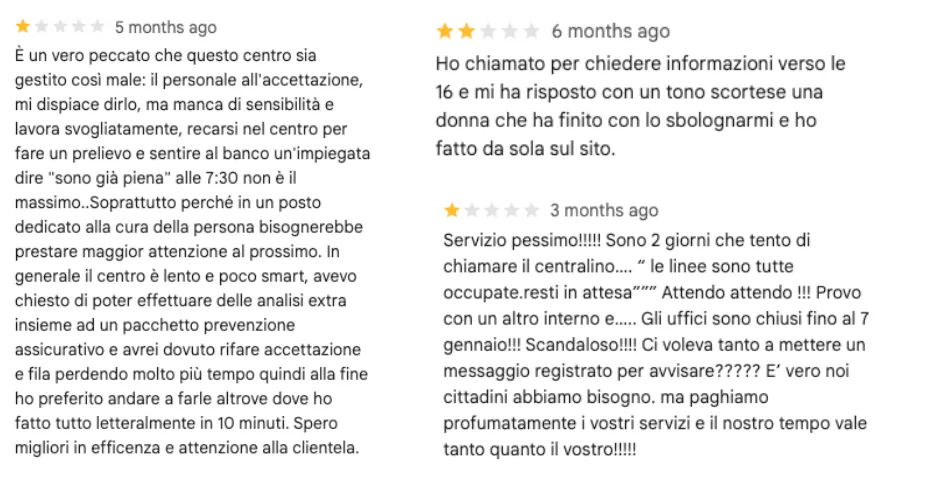
Examples of common reviews in reception congestion situations.
Alternative Solutions to Decongest the Call Center
Reducing phone traffic without sacrificing service quality or inflating administrative costs is now possible in many ways thanks to technology. Let's look at the main options that can be implemented right away.
1. Call-back Systems
The so-called "call-back" consists of the patient submitting a request to be contacted back. With this simple but effective method it is possible to:
Reduce abandonment rates, because the patient – even without completing an actual booking – knows their request will be taken care of.
Smooth out activity peaks, distributing calls throughout the entire working day.
Help operators, who can better manage callback flows, including splitting them by contact person and type.
A call-back system was implemented, for example, by Centro Medico Metica through the virtual assistant on the company website, where patients are offered the option of being called back by phone after leaving their details and phone number.
In this case, for example, 15% of client-requested actions consist of a "callback request" (most of which are to receive more details about specific services or to request documentation).
2. Intelligent Assistants
While call-back systems enable better peak management, AI assistants – in the form of chatbots or voicebots – allow both managing peaks and handling the most transactional requests, enabling human operators to focus on more urgent or complex inquiries.
Today, AI assistants can typically support a reception desk on many fronts:
Answering frequently asked questions
Managing bookings, modifications, and appointment cancellations, including integration with practice management software
Conversing in natural language via phone or chat, in multiple languages
Transferring the call to human staff when needed
Extending 24/7 availability across multiple simultaneous lines
Monitoring call data in real time for analysis and continuous improvement.
Among AI assistants specialized in healthcare, for example, Virtual Reception is an end-to-end voice solution that integrates from the switchboard number to the healthcare management system via API. This way, the tool can handle 100% of requests, eliminate missed calls, and reduce transactional workloads, transferring only the most complex conversations to staff.
3. IVR with Intelligent Routing
The IVR (Interactive Voice Response) solution with voice recognition can identify the reason for the call and route the request to the most appropriate channel, combining capabilities such as:
Automatic identification of the caller's "intention" through language models (such as Large Language Models)
Prioritization of urgent medical calls that take precedence over administrative matters;
Automatic routing based on pre-determined rules.
The intelligent IVR solution is available in various Customer Relationship & Experience platforms such as Genesys – a contact center platform provider – to receive incoming calls and route them to the appropriate service queues, while also ensuring traditional routing.
4. Online Booking
Web portals and apps allow patients to book, modify, or cancel appointments independently, without the need for synchronous interaction with the facility. The main advantages of online booking are:
24/7 availability, including outside business hours and on weekends;
Reduced workload for the switchboard;
Integration with the facility's internal Booking Management System (BMS).
An effective example is that of the Virginia Women's Center (USA) which, thanks to a self-service booking system, achieved 25% of self-booked appointments in 6 months, reducing incoming call volume by 1/4 and new employee training time by 70%.

Minimizing the "Cost-to-Serve" Through a Layered Hybrid Model
In the context of healthcare switchboard management, a winning strategy for balancing economic sustainability and service quality is the strategic alignment of the so-called "cost-to-serve". This approach distributes different types of requests across specific channels based on their complexity and the perceived value to the user.
The "call peak" problem we analyzed finds its optimal solution in a layered model that optimizes resources:
The simplest and most transactional requests – basic information, appointment modifications or cancellations – can be effectively handled by self-service systems such as the web portals and apps we saw in the Virginia Women's Center examples. These tools are always available, require a modest initial investment, and drastically reduce daily operating costs.
At an intermediate level we find chatbots, ideal for handling standardizable but slightly more complex requests, such as specialist visit confirmations or information about medical procedures. Just like the AI assistants described in this article, they represent a low-cost solution that significantly reduces the workload of human operators.
For more sophisticated requests, voicebots offer a natural voice interaction that allows for more empathetic and detailed communication. These systems, while requiring a larger investment than chatbots, create value in the user experience and significantly reduce call volumes destined for operators.
Human operators, the most valuable resource, can thus focus exclusively on high-complexity or high-relational-value activities, exactly as indicated in the section on IVR with intelligent routing.
Implementing this hybrid model not only solves the congestion problems described in the first part of the article, but also avoids the negative consequences such as lost business, reputational damage, staff overload, and "no-shows".
The key to success lies in positioning the right service at the right cost level, leveraging each channel for its specific capabilities and transforming the switchboard into that "intelligent multichannel system" that puts the patient at the center and prepares healthcare facilities for modern, effective, and sustainable management.
The Real ROI of Automating Healthcare Contact Centers
Adopting advanced technology for the healthcare switchboard is a true investment with measurable financial return. In fact, when we look at real-world data from healthcare facilities in 2026, we see why intelligent automation of reception workflows delivers positive ROI through two fundamental levers: cutting waste and creating new revenue.
1. Reduction of Operating Costs
Automated systems allow a sharp reduction in costs tied to inefficiency:
Breaking past the human ceiling: A reception operator typically handles 60–80 calls per day. By handing transactional requests (information, opening hours, cancellations) to AI, you break through this physical limit without hiring additional staff, while upskilling operators toward higher-value in-person welcoming.
Efficient peak management: Sizing your team for "Monday mornings" or agenda openings means high fixed costs. An AI assistant such as Virtual Reception absorbs peaks (handling dozens of simultaneous calls), enabling estimated savings of 20% to 30% on extra headcount or outsourced call center costs.
2. Revenue Growth
Technology cuts costs and recovers lost revenue:
Recovering missed calls (ROI): Assuming an average value of €80 per service, recovering just ten "typically missed" calls per day (with an average booking conversion rate of 20%) generates more than €5,000 in additional annual margin (NB: assuming a 10% margin on revenue).
Fewer no-shows: Missed appointments are a straight loss. AI tools let anyone cancel or reschedule whenever they remember—at any time of day. In this way, no-shows can be reduced by 25–40%.
Retention: Acquiring a new patient costs 5–7 times more than keeping an existing one. Offering an "Amazon-style" experience without phone queues reduces patient frustration and limits the time spent on this activity, sharply increasing loyalty to the facility.
3. Fast Investment Payback
This is where the paradigm shifts radically. Until recently, technologies to decongest the switchboard required long payback periods, due to high setup costs or the effort needed to "educate" patients to use new tools. Here is how break-even timing varies across solutions:
IVR systems with routing: They require technical configuration and often only route the call without resolving it. Because they drive high abandonment among patients who dislike numeric keypads, ROI struggles to turn positive quickly, limited to modest savings on routing time.
Break-even: 12–18 months.
Online booking portals: They are an excellent option for more digital-savvy users. However, they require upfront investment for development or website integration, plus marketing effort to change patient habits.
Break-even: 6–10 months.
AI agents (Virtual Reception): The generational leap is clear. The AI agent does not ask patients to download apps, browse sites, or press keys: patients simply contact the facility as they always have—by phone or WhatsApp. Unlike older technologies, fixed costs are optimized and usage-based spend is covered immediately by extra revenue from recovered calls. The key takeaway: with as few as ten inbound calls per day, Virtual Reception covers your investment and starts making you money.
The Benefits of Automation in Healthcare Call Centers
Automating part of the front-desk and call center activities is not just a technology choice, but a strategic lever for improving the entire patient reception system.
The solutions we've examined offer tangible benefits for both patients and healthcare staff:
Reduced waiting lists
Greater patient satisfaction
Optimized human resources
These benefits are not just a matter of comfort – they can directly influence patient health. An inefficient phone system can cause patients to give up, delay diagnoses, and generate widespread frustration. New technologies make it possible to transform the switchboard into an intelligent multichannel system. This doesn't mean replacing human interaction, but enhancing it, freeing staff from endless queues and repetitiveness. It's a "win-win" strategy that puts the patient at the center and prepares healthcare facilities for modern, effective, and sustainable management.
Related Articles
The Must-Have AI Tools to Manage Your Medical Center in 2026
Discover the most effective artificial intelligence tools to optimize the operational management of your medical center: from document drafting to virtual assistants.
Read moreThe AI Paradox: 10 Front Desk Activities With an Increasing Human Touch

Discover how artificial intelligence is redefining the role of healthcare front desks, automating repetitive tasks and enhancing high-touch human activities.
Read more