10 KPIs You Need to Know in 2026 for Healthcare Call Centers

A comprehensive guide to the essential Key Performance Indicators for monitoring and optimizing the performance of your healthcare call center.
Table of Contents
In healthcare, the call center is not just a support service: it is the first point of contact between the patient and the facility, often the gateway to the care journey. Monitoring the right KPIs means ensuring accessibility, reducing the risk of patient drop-off, and delivering a positive experience from the very first phone call.
Every missed call is not just a management issue – it can turn into a patient who gives up on a visit, a checkup, or a treatment. That's why it's important to track what happens in call centers and during patient intake at the front desk through KPIs – Key Performance Indicators. KPIs help identify where patients are being lost, what generates dissatisfaction, and how to optimize processes to turn every call into an appointment.
Why Are KPIs Vital for the Patient Experience?
Measuring and monitoring the right call center KPIs is essential for evaluating service quality and the patient experience. Data shows that many healthcare call centers struggle to keep up with demand.
In the United States, for example, a study of clinics and hospitals found that during peak hours, staff can handle an average of only 60% of incoming calls, with a deficit of approximately 23 operators per 2,000 daily calls. This results in very high wait times: 4 minutes and 24 seconds on average (Source: Top Healthcare Call Center Metrics That Matter).
Answering the phone in healthcare is therefore not an organizational detail, but an integral part of care: if hundreds of patients call every day at all hours, the facility must be able to handle those contacts. Otherwise, patients are lost and people may not receive the information or care they need, with negative impacts on their health.

The Key KPIs and Their Market Benchmarks
When it comes to patient experience and customer service quality in healthcare, certain KPIs become particularly relevant. Here are the main indicators that every healthcare facility should carefully monitor:
1. Call Abandonment Rate – CAR
The CAR indicates the percentage of patients who hang up before speaking with an operator. Every missed call represents a patient who may give up on the service or go elsewhere. Abandonment is often caused by excessively long waits or complex IVR systems. In healthcare, the average value is around 7%, while 5% would be a realistic target as reported in the Hyro.ai report "The State of Healthcare Call Centers 2023"
2. Average Speed of Answer – ASA
ASA measures how many seconds, on average, it takes a patient to get an answer. The standard considered acceptable is between 20 and 50 seconds, but in healthcare call centers the average recorded by Hyro.ai is 4.4 minutes, well beyond the tolerance threshold. After the first two minutes, the probability of abandonment increases rapidly, with a direct impact on the drop-out rate.
3. First Call Resolution – FCR
FCR is a crucial efficiency indicator: it measures how many requests are resolved on the first call, without the need to call back or wait for a follow-up. According to Hyro.ai, the healthcare industry average is below 55%, and only 1% of call centers manage to achieve an FCR above 80%. Aiming for at least 70–75% would mean reducing the workload on operators and significantly improving the patient experience.
4. Patient Satisfaction Score – PSAT
PSAT remains the most direct thermometer of perceived quality. It is usually measured through surveys or reviews, and a score above 80–85% is considered good. However, when looking at the majority of reviews, ratings deteriorate significantly when it comes to experiences with the front desk and the intake process.

5. Patient Conversion
The patient conversion rate is a very concrete KPI: it indicates how many calls turn into actual bookings and how many interactions help reduce no-shows. In the most efficient healthcare call centers, the conversion rate reaches 70–80%: this means that the vast majority of people who call find an answer and complete the booking process.
6. Average Handling Time – AHT
AHT represents the average duration of a call, from start to finish. In healthcare, the benchmark ranges between 4 and 6 minutes: times that are too short risk reducing quality, while times that are too long generate inefficiencies. However, the current average in healthcare call centers is 6.6 minutes, a value that confirms the difficulty of maintaining a balance between efficiency and human interaction (source: Hyro.ai).
7. Occupancy Rate
The OR measures how much time operators spend on the phone compared to total working hours. An ideal OR falls between 75% and 85%: above 90% operators risk burnout, below 70% inefficiencies arise. However, in healthcare call centers, during peak hours staff can often only cover 60% of demand, because operators are required to manage multiple channels simultaneously. At these times, it becomes crucial to increase dedicated resources during peak hours and extend service hours to handle more requests.
8. Cost per Call Handled
The cost per call is the key indicator of economic sustainability. In healthcare settings, it generally ranges between $2 and $6, considering ancillary expenses such as staff salaries, technology, energy, space, training, etc.
9. No-Show Rate
The no-show – the phenomenon of missed appointments – has a direct impact in healthcare on both the organization of clinical schedules and the economic sustainability of the facility: every missed appointment represents lost physician time and a service that doesn't reach the patient. The call center plays a decisive role in reducing no-shows and guiding patients through to actual service delivery. Through phone reminder activities or SMS confirmations, the most efficient centers manage to reduce missed appointments by 20–30%, freeing up slots that can be reassigned to other patients and thus improving overall productivity.
10. Retention Rate
Retention is the percentage of patients who return to book at the same facility, and it measures the medical center's ability to retain a patient by maintaining a relationship with them. High retention reaches 70–80% of patients returning, indicating equivalent satisfaction and loyalty.
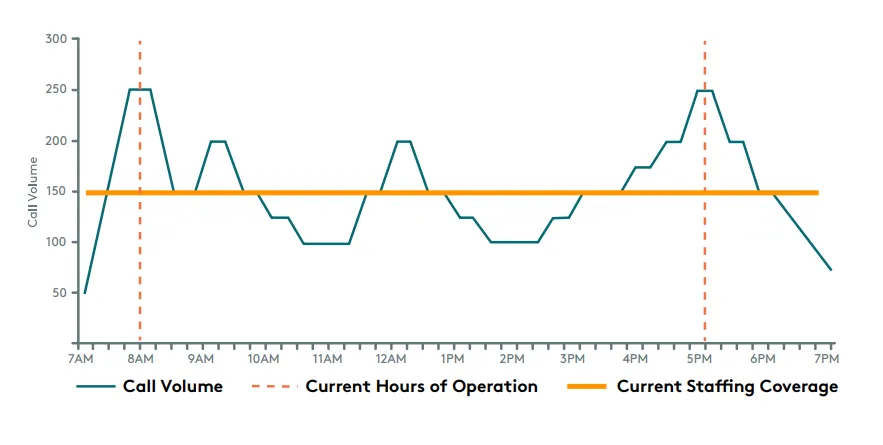
Source: Envera Health – Access Healthcare
Conclusions
Monitoring the 10 KPIs described is not an academic exercise: it's the only way to know if your healthcare call center is effective for patients and sustainable for the facility.
With indicators like abandonment rate, average wait time, and FCR, you can intervene quickly to improve the phone experience. With metrics like conversion, avoided no-shows, and retention, you measure the real value created: how many patients become paying clients and how many return. Finally, with AHT and cost per call, you understand whether the model is economically sustainable.
We recommend setting realistic targets for each KPI, measuring them on a regular basis, and comparing them with industry benchmarks. Numbers alone are not enough: root cause analysis and corrective action are also needed.
A healthcare call center that answers quickly, resolves issues on the first contact, and fosters retention is not just a service: it's an integral part of patient care – and can become a competitive advantage for the facility.
Related Articles
4 Examples of Artificial Empathy in AI Assistants

Explore how chatbots and voicebots can simulate empathy in customer service, with real-world examples in healthcare, banking, tourism, and HR.
Read moreCyber Attacks in Healthcare: Escalation and Countermeasures

Analysis of the escalation of cyber attacks in the Italian healthcare sector, with prominent cases, common attack vectors, and practical solutions to strengthen cybersecurity.
Read more