IVR vs Virtual Reception: pros and cons of managing healthcare front desk with AI
Phone intake is the first step in the care journey, a decisive moment for conveying trust and professionalism to the patient. Moving from traditional systems such as keypad IVR to the new frontier of Artificial Intelligence is a valuable opportunity to raise service quality.
Table of Contents
Press 1 to speak with an operator: the IVR solution for traditional front desk
Anyone who has ever called a medical practice outside opening hours knows that recorded voice: neutral, mechanical, listing options one after another, hoping your need fits somewhere in the menu. That is IVR, Interactive Voice Response, the system that for decades represented the standard solution for handling call flows in healthcare front desks.
Its operating principle is simple: the patient calls, is greeted by a pre-recorded message, and is guided through options selected through the phone keypad. Requesting a report, canceling an appointment, being placed on hold to speak with an operator: everything passes through that rigid, mechanical path.
Born as a tool to ease front-desk workload, IVR guaranteed a form of continuous "presence" for years. But "presence" does not mean operativity, and this is precisely the core limitation of these traditional systems.
These systems, limited to routing calls without real interactivity or integration with booking management software, do not provide concrete support to the front desk. Their autonomy is in fact around 10-15%, confined to basic information such as opening hours, inevitably delegating the management of almost all call traffic to operators.

The interactivity of Healthcare Virtual Reception
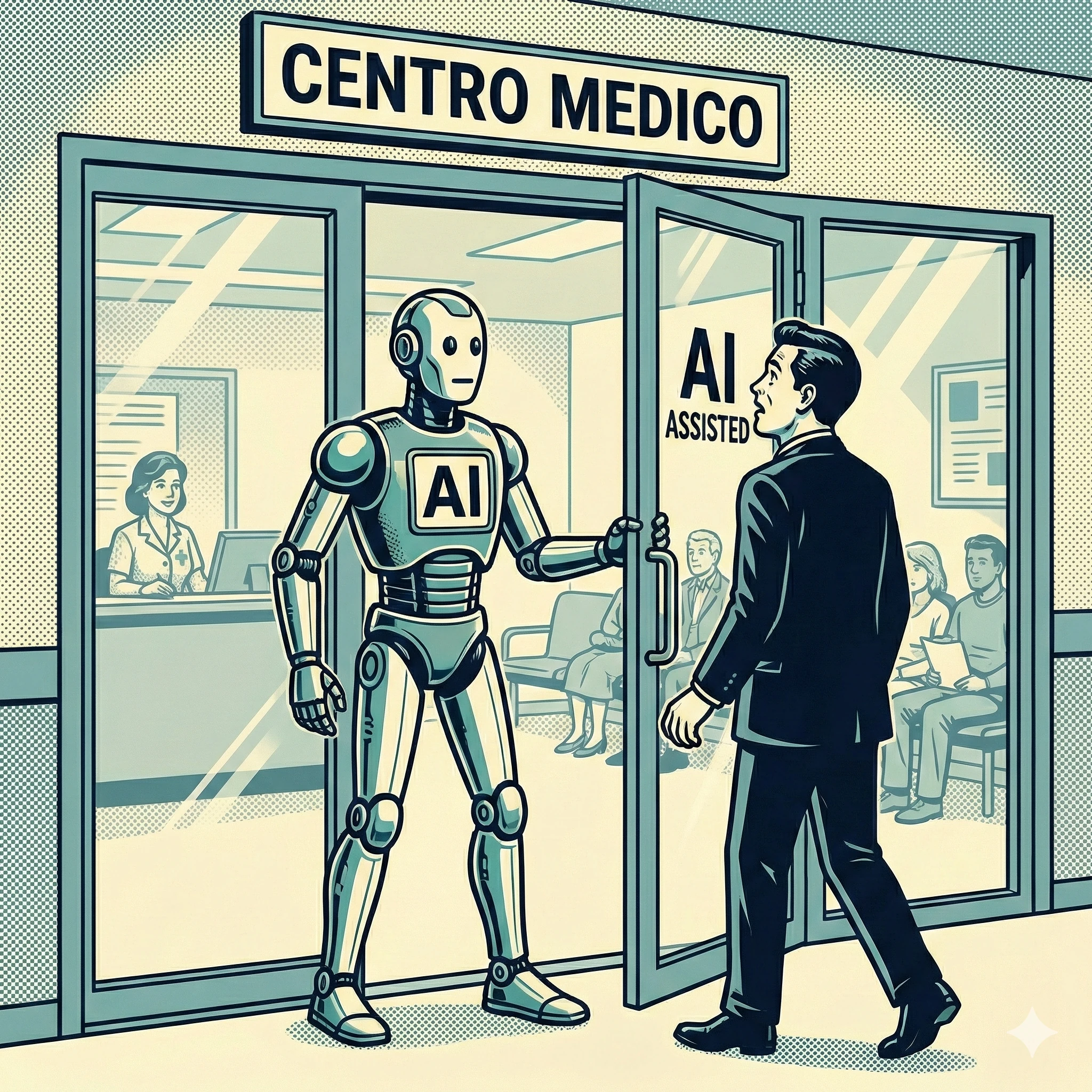
With the rise of conversational Artificial Intelligence, the very concept of healthcare front desk is undergoing deep transformation. Many clinics and outpatient centers are leaving behind keypad menus and adopting a radically different model: AI voice assistants, capable of acting as an organic extension of the staff and handling unlimited volumes of requests without quality degradation, regardless of time, day, or number of simultaneous incoming calls.
Unlike traditional IVR, AI assistants such as Virtual Reception listen and understand. AI decodes the specificity of each request and provides personalized real-time responses, avoiding the need for the patient to interpret and choose between standardized recorded options.
These assistants operate in perfect synergy with human staff, absorbing the most repetitive and transactional tasks, autonomously handling up to 15-20% of bookings or appointment changes, and resolving an additional 20-25% of informational requests (hours, insurance agreements, preparation instructions). The result is a new paradigm for healthcare intake: an intelligent front desk that converses, resolves, and converts, ensuring operational continuity 24 hours a day.
Pros and Cons: IVR or Healthcare Virtual Reception
Run2AI Healthcare Virtual Reception
Pros
Available and autonomous 24/7, handling multiple simultaneous calls without leaving anyone waiting
Sustains real, adaptive conversations, understands patient intent, and responds through specialist flows built for healthcare
Autonomously manages common front-desk actions and real-time bookings, cancellations, and callback requests
Integrates with common healthcare management software and phone systems
Requires no behavior change from patients: they keep calling or writing on WhatsApp exactly as before
Break-even is immediate: about 10 successfully handled calls per day for one month can cover the initial investment and start generating additional net profit
Cons
Requires an initial configuration phase to adapt conversation flows to each facility
Like any AI-based system, it requires periodic monitoring to ensure interaction quality over time
Represents an organizational shift that may require an adaptation period for healthcare facilities

Traditional IVR
Pros
Ensures continuous 24/7 phone presence, even outside facility opening hours
Reduces calls reaching operators directly by categorizing and routing calls, partially easing peak-time load
Has initially contained implementation costs and a consolidated technology familiar to most patients and healthcare facilities
Cons
Interaction is rigid and one-way: the patient does not dialogue, but goes through a pre-determined menu that often does not reflect the real need
The system performs no action autonomously: every request must be completed manually by a human operator, generating bottlenecks and delays
High call abandonment caused by patient frustration, resulting in lost appointments for the facility
Does not integrate with clinical management systems, leaving fragmented data and transcription errors
Return on investment is slow: typically 12 to 18 months, with only marginal operating savings
Conclusion
The picture that emerges from this comparison is unequivocal. Traditional IVR offers presence: it answers, routes, and queues. But presence is not operativity, and every call ending with "please stay on the line, an operator will answer shortly" is a deferred promise. Healthcare Virtual Reception, instead, offers something structurally different because it is designed to act by resolving patient requests.
The cons of Healthcare Virtual Reception exist, but they are temporary and manageable. Initial setup is a one-time investment. Periodic monitoring is good management practice, not a recurring emergency. Organizational adaptation is a transition phase, not a permanent obstacle. These are typical frictions of any innovation, destined to decrease over time as the system learns and the facility gets used to operating at a higher standard.
By contrast, the cons of traditional IVR are structural and progressively more costly. They do not improve over time, because patient expectations keep rising while tolerance for voice menus decreases, widening the gap between what the system offers and what patients expect. Patients who hang up do not always come back, and poor reputation translates into lost revenue.
Choosing today between traditional IVR and Healthcare Virtual Reception is a strategic decision, aligned with technological evolution that increasingly puts patient experience and operational efficiency at the center.
Frequently asked questions
What is the main difference between an IVR system and healthcare Virtual Reception?
Traditional IVR is a static filter: it routes calls through rigid numeric menus without performing any action independently. Healthcare Virtual Reception understands natural language and directly resolves the patient's request, handling bookings, cancellations, and callback requests through integration with healthcare management systems.
How long does it take to recover the investment in healthcare Virtual Reception?
According to Run2AI installation data (2026), break-even is immediate: roughly 10 successfully handled calls per day for one month are enough to cover the initial investment. Traditional IVR has an average return on investment of 12 to 18 months, with only marginal operational savings.
How many bookings does Virtual Reception handle independently?
In Run2AI installations, Virtual Reception independently handles up to 15–20% of bookings or appointment changes, absorbing the most repetitive and transactional tasks and leaving complex requests to reception staff (Run2AI data, 2026).
Does traditional IVR still have advantages over an AI assistant?
Yes: it guarantees continuous 24/7 phone presence, has initially lower implementation costs, and is a technology familiar to patients and facilities. However, its limits are structural: it does not perform actions independently, does not integrate with clinical management systems, and generates a high call abandonment rate.
What is the main difference between an IVR system and healthcare Virtual Reception?
Traditional IVR is a static filter: it routes calls through rigid numeric menus without performing any action independently. Healthcare Virtual Reception understands natural language and directly resolves the patient's request, handling bookings, cancellations, and callback requests through integration with healthcare management systems.
How long does it take to recover the investment in healthcare Virtual Reception?
According to Run2AI installation data (2026), break-even is immediate: roughly 10 successfully handled calls per day for one month are enough to cover the initial investment. Traditional IVR has an average return on investment of 12 to 18 months, with only marginal operational savings.
How many bookings does Virtual Reception handle independently?
In Run2AI installations, Virtual Reception independently handles up to 15–20% of bookings or appointment changes, absorbing the most repetitive and transactional tasks and leaving complex requests to reception staff (Run2AI data, 2026).
Does traditional IVR still have advantages over an AI assistant?
Yes: it guarantees continuous 24/7 phone presence, has initially lower implementation costs, and is a technology familiar to patients and facilities. However, its limits are structural: it does not perform actions independently, does not integrate with clinical management systems, and generates a high call abandonment rate.
Related Articles
Essential AI tools to manage a medical practice in 2026
A practical overview of high-impact AI tools that improve operations, productivity, and patient service quality.
Read more10 KPIs for healthcare call centers

Key metrics to measure phone performance, reduce missed calls, and improve patient experience at scale.
Read more